
Congratulations – you just bought a new home! Whether you’re unpacking boxes in Spencer’s Crossing, settling into your place in Audie Murphy Ranch, or getting the keys to a home in Roripaugh Ranch, there’s a lot to figure out in those first few months. Where’s the main water shut-off? Which breaker controls what? How does the thermostat work?
But here’s one thing that almost never comes up during the buying process, and rarely makes it into the stack of paperwork your builder hands you: your tankless water heater needs regular maintenance. Specifically, it needs to be flushed at least once a year.
I’m Joel, and I am the owner/operator of Royal Flush Tankless Water Heater right here in the Murrieta and Temecula area. I’ve flushed over 1000 tankless water heaters across Southwest Riverside County, and I can’t tell you how many times a homeowner has said to me, “I didn’t know the tankless water heater needed to be serviced.”
So, I wrote this post for you. If you recently moved into a newer home in our area, this is the guide you probably should have gotten at closing but didn’t. I’ll walk you through how to find your unit, what it does, why it needs maintenance, and exactly what to do after your first year of ownership.
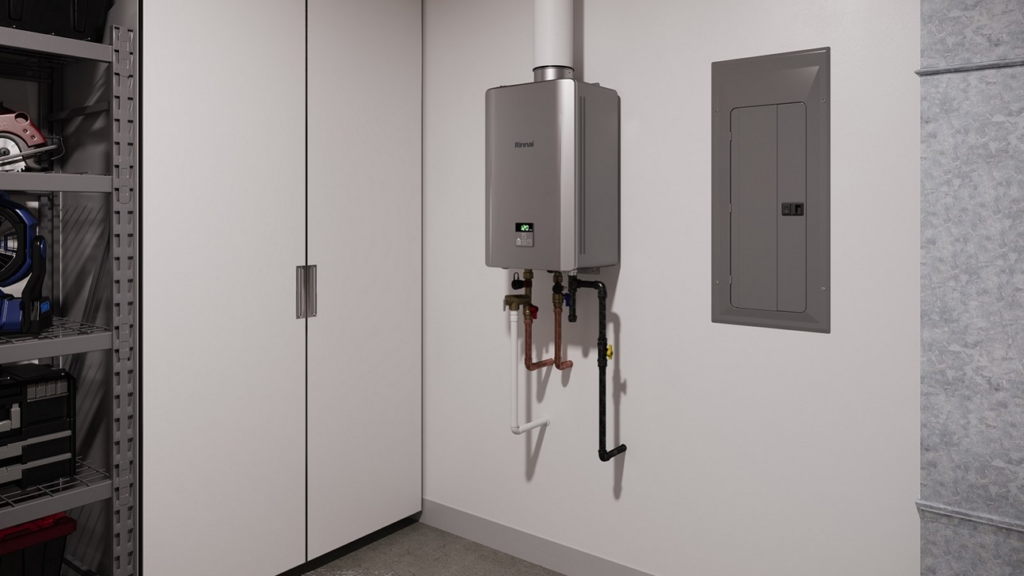
Do I Even Have a Tankless Water Heater?
If your home was built after roughly 2014 in the Temecula Valley, Murrieta, Menifee, or surrounding areas, there’s a very good chance it came with a tankless water heater. California’s energy efficiency standards have been pushing builders toward tankless systems for over a decade now.
Common brands you’ll see in local new builds include Rinnai, Navien, Noritz, and Rheem. The brand name is usually printed right on the front of the unit. You’ll also see a model number and serial number on a label on the left or right side of the unit. Jot those down or snap a photo. You’ll need them for warranty registration (more on that in a minute).
| Quick tip: Take a photo of the entire unit, plus a close-up of the label with the model and serial number. Save it in your phone. You’ll want it later. |
How a Tankless Water Heater Works (The 30-Second Version)
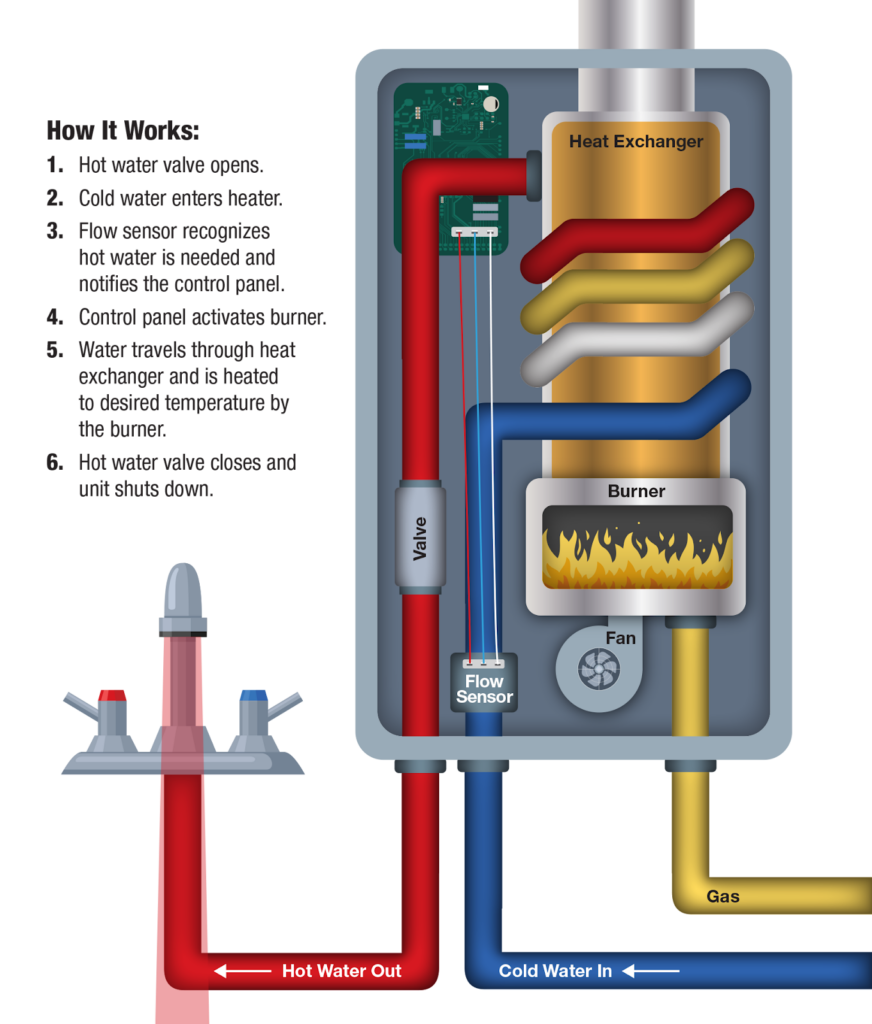
Unlike a traditional water heater that stores 40 or 50 gallons of hot water in a tank and keeps it heated all day, a tankless unit heats water on demand. When you turn on a hot water faucet, cold water flows through the unit, passes through a heat exchanger, and comes out hot on the other side. When you turn the faucet off, the heater stops firing.
That’s why tankless heaters are more energy efficient: they’re not keeping a huge tank of water hot 24 hours a day. It’s also why they can last 20 to 25 years with proper care, compared to 10 to 12 years for a traditional tank. And it’s why they cost more to replace. Typically, in the range of $3,000 to $5,000 installed.
That last number is the one I want you to remember. Because whether this unit lasts 8 years or 25 depends almost entirely on one thing: maintenance.
Why Flushing Matters (Especially Here in the Temecula Valley)
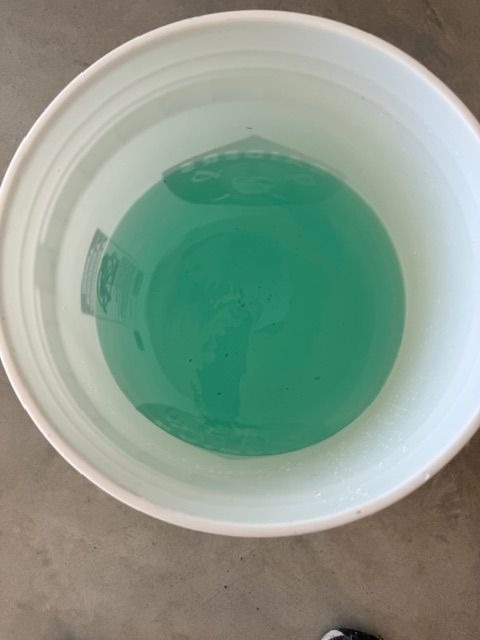
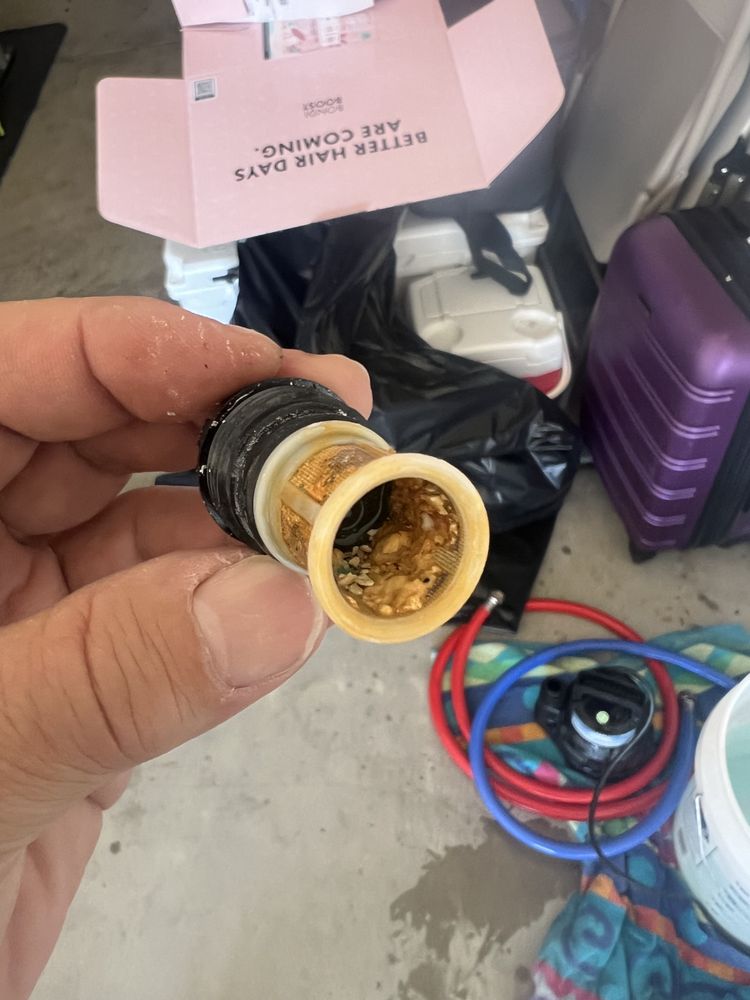
Here’s what happens inside your tankless heater over time. The water flowing through your pipes carries dissolved minerals like calcium and magnesium. When that water gets heated rapidly inside the heat exchanger, those minerals form hard, chalky deposits called scale. Think of it like the white crusty buildup you see around your faucet aerators or showerheads. Now imagine that happening inside the narrow passages of your heater’s heat exchanger.
Here’s the thing about our area: depending on where you live, your water comes from one of two major districts and both deliver water with elevated mineral content.
Rancho California Water District serves much of Temecula and parts of Murrieta, drawing from both local groundwater and imported sources. Their water is known to be moderately hard, carrying elevated levels of calcium and magnesium that cause scaling in pipes and appliances over time.
Eastern Municipal Water District (EMWD) serves a large portion of Murrieta, Menifee, Winchester, French Valley, and Hemet. EMWD’s water comes from a mix of Colorado River imports (treated at the Skinner Filtration Plant in Winchester), State Water Project deliveries, and local groundwater, including desalinated groundwater from their Menifee facilities. All of those sources carry dissolved minerals. The Colorado River supply in particular travels hundreds of miles through the desert before it reaches your tap, picking up mineral content along the way.
The bottom line is the same regardless of which district you’re in: our local water is hard enough to cause meaningful scale buildup inside a tankless heat exchanger within a year. And that buildup only accelerates from there.
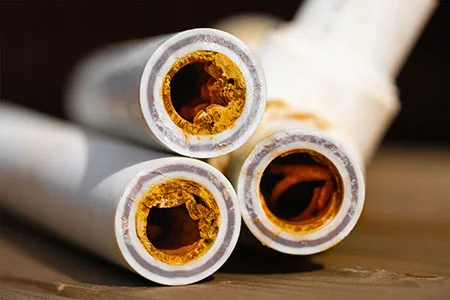
When scale accumulates in the heat exchanger, a few things start happening:
- Your hot water flow decreases as the mineral deposits narrow the pathways water travels through
- The unit has to work harder to heat the same amount of water, increasing your energy bills
- You may notice temperature fluctuations where water is hot one moment and lukewarm the next
- The heater starts throwing error codes, which can shut the unit down entirely
- In severe cases, the heat exchanger (the most expensive component in the unit) gets damaged beyond repair
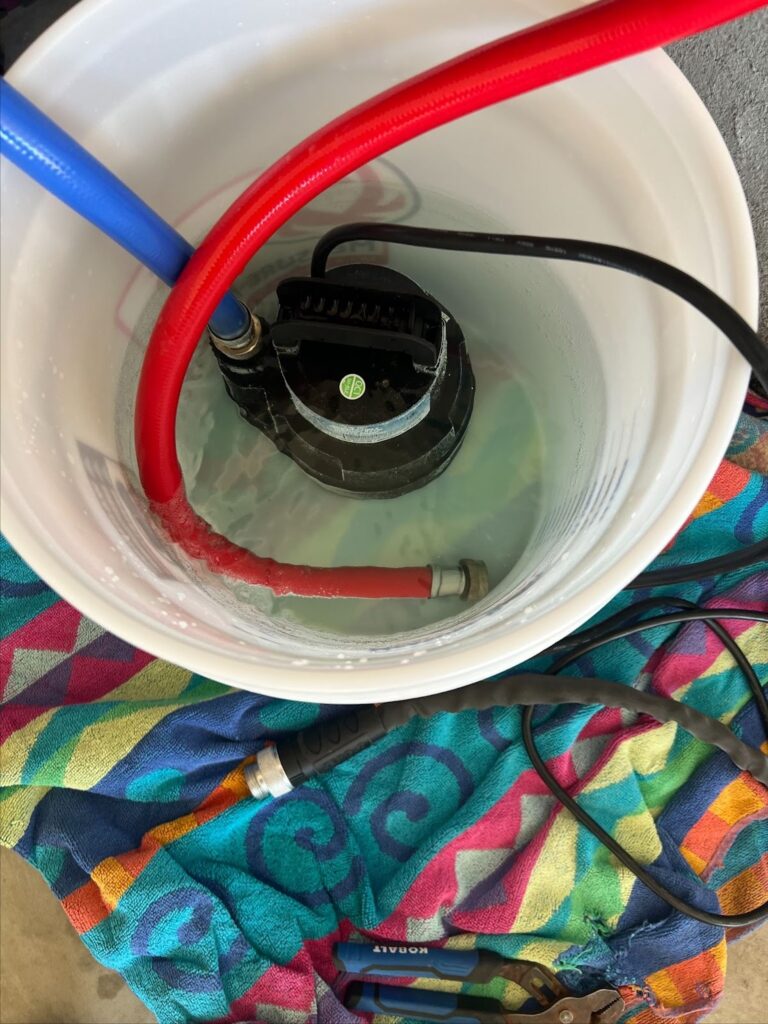
An annual flush solves all of this. A professional connects a small pump to the unit’s service valves and circulates a descaling solution through the heat exchanger for about 30 to 45 minutes. The solution dissolves the mineral buildup, and your heater goes back to running like new. It’s a straightforward process, it’s affordable, and it’s the single most important thing you can do to protect your investment.
The Warranty Angle Nobody Tells You About
This is the part that really gets people’s attention. Most major tankless water heater manufacturers state they require regular maintenance to keep your warranty valid.
Let me say that again, because it’s important: if your heat exchanger fails at year 6 and you file a warranty claim, the manufacturer can deny it if you can’t show that the unit was properly maintained. Rinnai’s warranty explicitly states that annual professional maintenance, including flushing for scale buildup, must be documented. Navien’s warranty lists “failure to perform regular maintenance” and “scale buildup” as conditions that void their coverage.
Your First-Year Tankless Water Heater Checklist
Here’s the practical stuff. If you’ve recently moved into a new home with a tankless unit, work through this list in your first few months. None of it is difficult. It just takes a few minutes of attention now to save you headaches (and money) later.
1. Locate Your Unit
Find the tankless water heater in your home. Check the garage first. It’s mounted on the wall in the majority of homes I service. It could also be on an exterior wall (common in California), in a utility closet, or in some cases, in the attic. If you genuinely can’t find it, look for where the gas line enters your home and follow it.
2. Identify the Brand and Model
There’s a label on the front or side of the unit with the manufacturer’s name, model number, and serial number. Take a clear photo of this. You’ll need this information for warranty registration, when calling for service, and if you ever sell the home.
3. Register Your Warranty
This is the step almost everyone misses. Most manufacturers require you to register the product within 30 to 90 days of installation (or purchase of the home) to get the full warranty coverage. If you don’t register, you may still have some coverage, but it’s often reduced. For example, Rinnai extends labor coverage from 1 year to 5 years if you register within 90 days. Navien extends warranty terms from their “non-registered” to “registered” tier upon registration.
Registration is free and takes about 5 minutes on the manufacturer’s website. You’ll need the model number, serial number, and your installation date (for new construction, this is typically the date you closed on the home).
- Rinnai: www.rinnai.us/support/warranty
- Navien: www.navieninc.com/warranties
- Noritz: www.noritz.com/support/warranty
4. Note the Temperature Setting
Your unit came with a factory default temperature setting, typically around 120°F. This is the standard recommendation for safety (to prevent scalding) and is a good starting point. If you find your showers are too hot or not hot enough, you can adjust the temperature on the unit’s control panel. Most units let you set it in 1-degree increments.
5. Schedule Your First Professional Flush
Here’s the big one. Schedule a professional flush after the first 12 months of moving in. Even if the home is brand new, scale starts forming from the day the unit is first used. Whether you’re on Rancho Water or EMWD, our local water is hard enough that a year is plenty of time for meaningful scale to start forming inside the heat exchanger.
If you bought a resale home (not new construction) and the previous owner didn’t maintain the unit, schedule that flush sooner rather than later. I’ve serviced homes where the heater had never been flushed in 3, 4, even 5+ years. The amount of scale that comes out of those units would surprise you.
What About Water Softeners?
I get this question a lot: “If I install a water softener, do I still need to flush my tankless heater?”
The short answer is yes. A water softener significantly reduces the mineral content in your water, which means scale will build up more slowly. That’s a great thing, and I recommend water softeners to many of my customers. But “more slowly” doesn’t mean “not at all.” Even with a softener, some mineral content remains, and the heat exchanger will still accumulate deposits over time.
Think of it this way: a water softener and an annual flush are partners, not substitutes. The softener slows the buildup. The flush clears out whatever the softener didn’t catch. Together, they give your heater the best possible shot at a long, trouble-free life.
A Few Things You Might Notice in Your First Year
Since tankless heaters work differently from the traditional tank your last home might have had, here are a few things new owners commonly notice:
A brief delay before hot water arrives. This is normal. Because there’s no stored hot water, the heater has to fire up and heat the water in real time. Depending on how far the faucet is from the unit, it may take 10 to 30 seconds for hot water to reach you. This isn’t a malfunction, it’s just how the system works.
The “cold water sandwich.” If someone finishes a shower and you start one right after, you might get a few seconds of warm water (leftover in the pipes), then a burst of cold, then hot. This is caused by the brief gap between the leftover hot water and the freshly heated water. Just let it run for a moment and it’ll sort itself out.
The unit makes a clicking or whooshing sound. When the heater fires up, you’ll hear the ignition click and the gas burner engage. This is completely normal. What’s not normal: loud banging, persistent humming, or rattling. Those sounds can indicate scale buildup or a mechanical issue and are worth getting checked out.
Hot water runs out during heavy simultaneous use. Every tankless unit has a maximum flow rate (measured in gallons per minute, or GPM). If you’re running two showers, the dishwasher, and a washing machine all at once, you may exceed that capacity. This doesn’t mean the heater is broken. It means you’ve hit its limit. Stagger your hot water use during peak times and you’ll be fine.
The Quick-Reference Checklist

Here’s everything from this post condensed into a simple checklist you can print out or screenshot:
| Task | When |
| ☐ Locate your tankless water heater | First week |
| ☐ Photo the label (brand, model, serial number) | First week |
| ☐ Register the warranty on the manufacturer’s website | Within 30–90 days |
| ☐ Identify the service/isolation valves | First month |
| ☐ Check and clean the inlet water filter | First month, then every 6 months |
| ☐ Confirm the temperature setting (120°F recommended) | First month |
| ☐ Schedule your first professional flush | Before the 12-month mark |
| ☐ Set a recurring annual reminder for future flushes | After first flush |
| ☐ Consider a water softener (optional but recommended) | Anytime in year one |
Need Help? Let’s Get Your Heater on the Right Track
If you’ve recently moved into a home in Murrieta, Temecula, Menifee, Wildomar, Winchester, Hemet, or the surrounding communities, I’d love to help you get your tankless water heater set up for a long, healthy life.
For new customers, I offer your first flush at just $100 (regular price is $150). The service takes about 75 to 90 minutes, and I’ll walk you through everything from where your unit is, what condition it’s in, and what to watch for going forward. I’ll also help you with warranty registration if you haven’t done it yet.
You can schedule online anytime at royalflushtankless.com, or give me a call at (909) 353-3269. I’ll get you on the calendar at a time that works for your schedule.
Your tankless water heater is one of the most valuable appliances in your new home. A little attention in the first year goes a long way toward making sure it’s still running strong in year 20.
— Joel
Royal Flush Tankless Water Heater